How much does AI prompt research cost? What you pay to find the questions worth winning
What AI prompt research tools charge, what drives the price, and what one prompt research lookup costs in Seoprama, with AI Plus plans from $33.

- Prompt research finds the questions people ask AI assistants about your market. It's a different job from tracking, and it's usually needed once per topic, not every week.
- Most tools sell it inside a monthly AI visibility plan or an add-on to an SEO suite, so you pay for the month even if you research one topic.
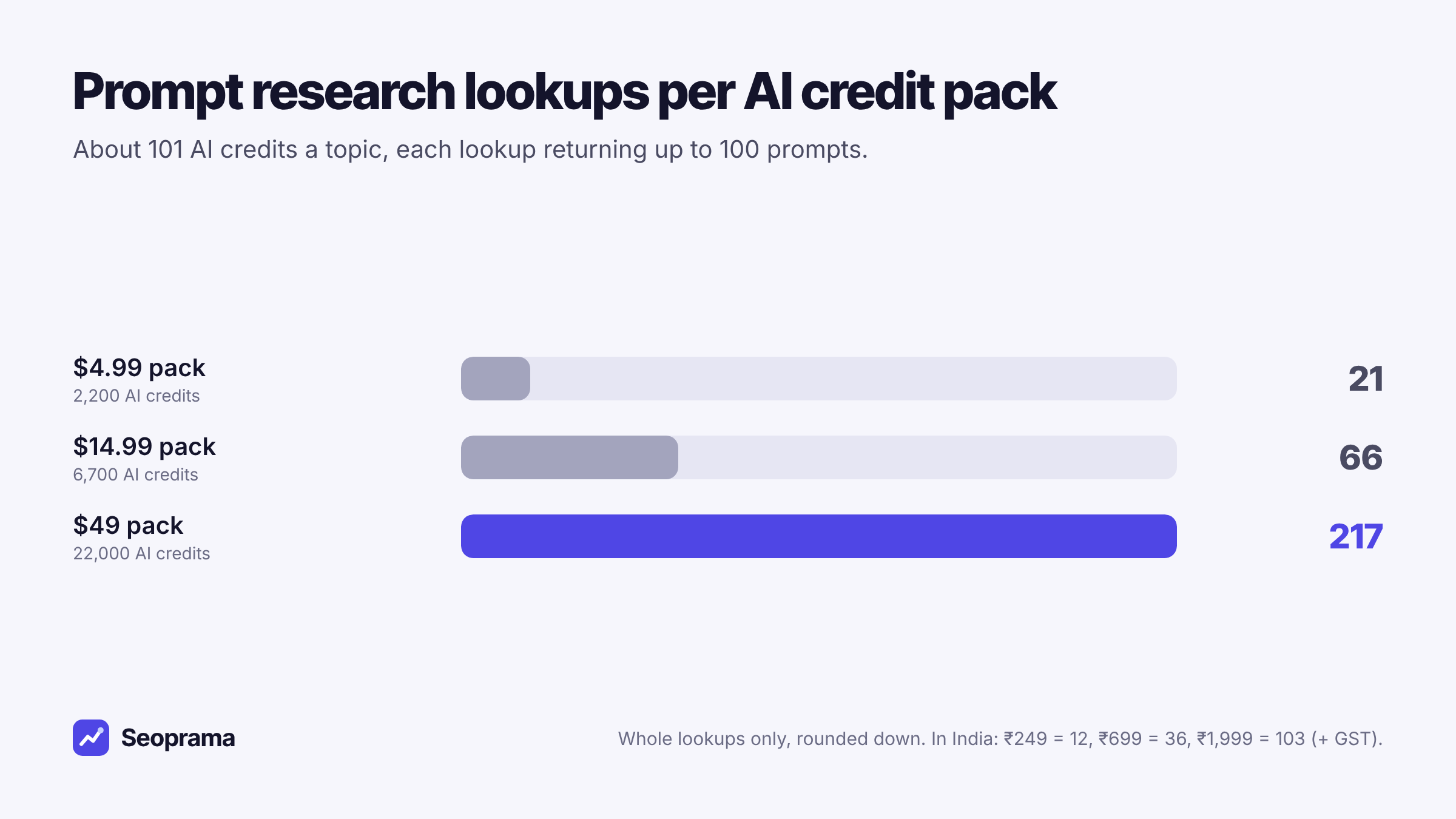
- In Seoprama one prompt research lookup is about 101 AI credits and returns up to 100 ChatGPT prompts. That's about 21 lookups in the $4.99 AI credit pack.
- AI Plus plans start at $33 a month (₹1,799 + GST in India) with 1,500 AI credits plus regular SEO credits.
- AI credits are a separate balance, and the $2.99 / ₹99 trial doesn't include any.
You’ve accepted that some of your customers now ask ChatGPT before they ask Google. Fine. But which questions? You can’t win an answer if you don’t know the question, and guessing at prompts is how you end up tracking twenty versions of “best tool for X” that nobody types.
That’s what prompt research is for. This post covers what AI prompt research costs, the pricing models you’ll run into, and the actual numbers for the AI prompt research tool in Seoprama, so you can work out your own budget before you spend anything.
What “prompt research” means here (it’s not about token costs)
Search for “AI prompt research cost” and half the results are calculators for what an API call to a language model costs in tokens. That’s a developer’s question. This post isn’t about that.
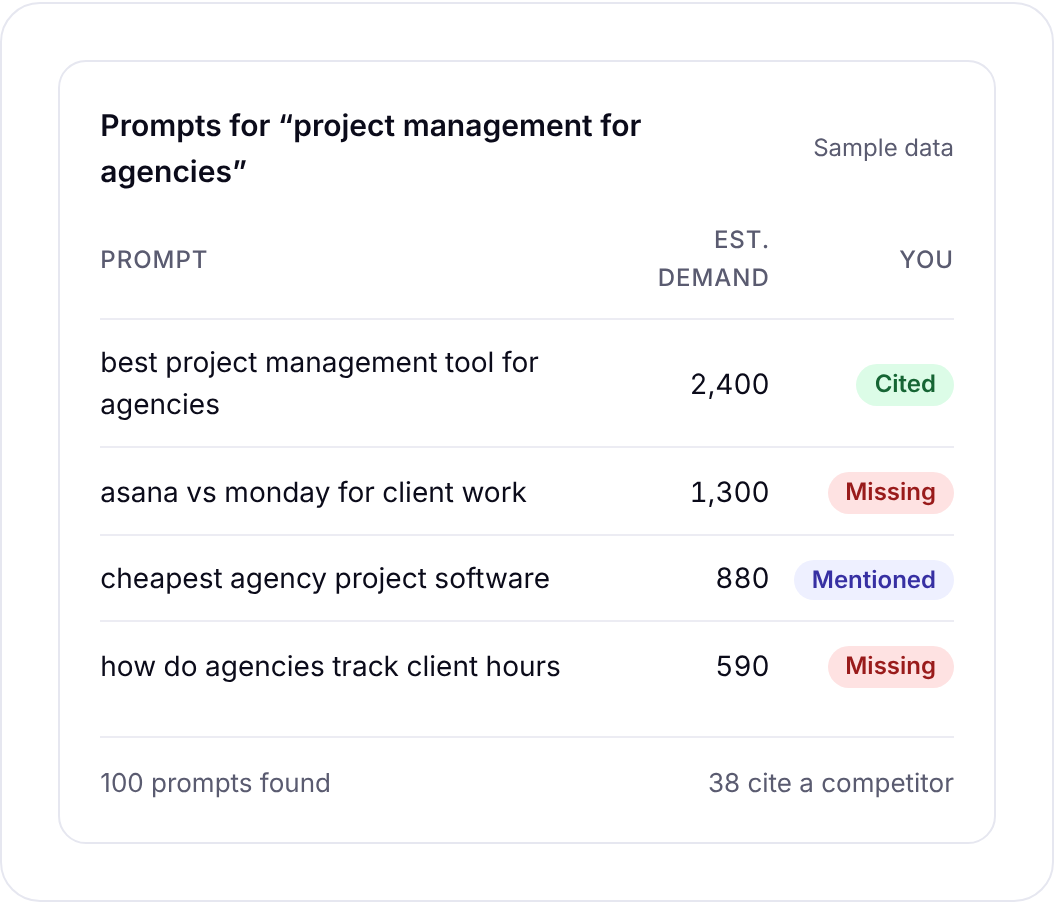
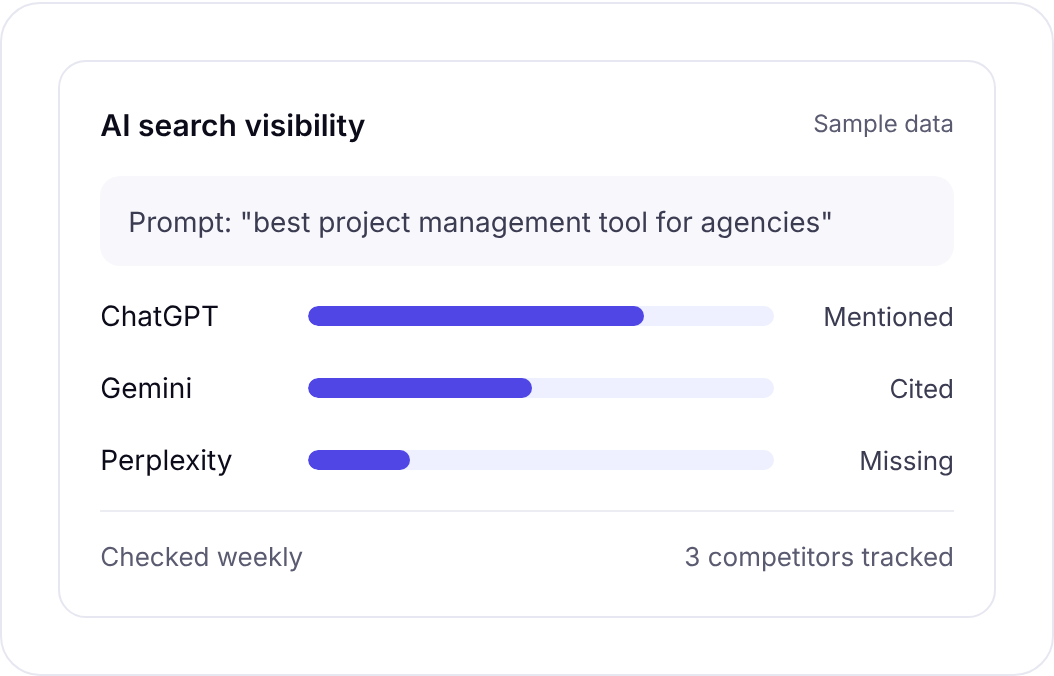
Prompt research, in the SEO sense, is keyword research for AI assistants. You give it a topic, say “project management for agencies”, and it gives you back the questions real people put to ChatGPT about it. For each question you want to know three things:
- How much demand there is, roughly.
- Which sites the AI’s answer cites.
- Whether your brand or site appears at all.
It’s a different job from prompt tracking. Research tells you which questions matter. Tracking asks those questions on a schedule and records whether you’re mentioned or cited over time.
You research a topic once, maybe again a quarter later. You track every week. If tracking is the part you’re pricing, what AI prompt tracking costs has the per-answer maths.
That difference matters for cost. Research is a one-off purchase per topic. Paying for it as if it were an ongoing service is where budgets leak.
The real questions, and which sites the AI answers cite.
How prompt research tools usually charge
Without naming prices, the market has three shapes.
An add-on to an SEO suite. The big SEO platforms sell AI visibility as a separate monthly add-on on top of their main plan. You get prompt research, tracking and reports together. Good value if you’d use all of it every week. Expensive if you wanted to research two topics.
A standalone AI visibility subscription. Newer tools built just for AI search usually bundle research with tracking, priced by how many prompts you can monitor. Research is often “included”, which really means it’s paid for by the tracking bundle.
Pay per lookup. You buy credits and spend them each time you research a topic. No monthly fee, and the cost is the same whether it’s your first lookup or your fiftieth. This is how Seoprama does it.
None of these is wrong. The question is which one matches how often you’ll actually run research. For most founders the honest answer is “a burst at the start, then rarely”.
What drives the price of prompt research
Whichever model you’re on, five things push the cost up or down.
1. Which AI assistants are covered. Each assistant is a separate data source. A tool covering five assistants has more to collect than one covering ChatGPT alone, and it’ll price that in.
2. How many prompts come back per topic. Ten prompts is a teaser. A hundred gives you enough to pick from properly.
3. Whether citations are included. Knowing that a question exists is half the value. Knowing which sites the answer cites tells you who to beat, and that’s more data to collect.
4. How fresh the data is. Re-running a topic every hour costs the provider money. Most tools cache results for a period so repeat lookups are cheap or free.
5. Seats. Some plans charge per user. If your marketer, your founder and an outside consultant all want access, check that line before anything else.
When you compare tools, these are the five questions to ask. Price per month tells you little until you know what one lookup actually gets you.
What AI prompt research costs in Seoprama
In Seoprama, one prompt research lookup costs about 101 AI credits. The app shows the cost before you run it.
Here’s what one lookup returns:
- Up to 100 real questions people ask ChatGPT about your topic, with off-topic ones filtered out.
- The sources each answer cites, and whether your domain is one of them.
- Whether your brand is named in the answer.
- An estimated demand figure for each prompt, used to rank them. It’s built from Google “People also ask” data, because AI companies don’t publish how often a question is asked. Treat it as a guide, not a count.
Results refresh at most once a day, so running the same topic twice in a day doesn’t cost you twice.
AI credits are a separate balance
This trips people up, so it’s worth being clear. Prompt research is paid for with AI credits, not the regular credits you use for keyword research, rank tracking or backlinks. AI credits are only used by AI features: prompt research, prompt tracking, and keyword research where AI picks the keywords from your website (about 92 AI credits).
You buy them in their own packs:
| AI credit pack | AI credits | Prompt research lookups (about 101 each) |
|---|---|---|
| $4.99 | 2,200 | 21 |
| $14.99 | 6,700 | 66 |
| $49 | 22,000 | 217 |
| ₹249 + GST | 1,300 | 12 |
| ₹699 + GST | 3,700 | 36 |
| ₹1,999 + GST | 10,500 | 103 |
The lookup counts are rounded down to whole lookups. Worked out per lookup, that’s roughly $0.23 on the $4.99 pack, a little less on the bigger ones, and about ₹19 + GST on the Indian packs. Pounds and euros are on the pricing page.
AI credits you buy never expire. Research three topics this month and the rest of the pack waits for next quarter.
Buy credits once and spend them only when you run something. Bigger packs give more credits per dollar.
AI Plus plans: when a monthly plan makes sense
If you’ll use AI features every month, there’s also AI Plus, a set of monthly plans that bundle AI credits with regular SEO credits.
| Plan | Price | AI credits a month | What that covers |
|---|---|---|---|
| AI Plus Basic | $33 (₹1,799 + GST) | 1,500 | About 14 research lookups, or about 55 prompts tracked weekly |
| AI Plus Pro | $69 (₹3,799 + GST) | 4,000 | About 39 research lookups, or about 150 prompts tracked weekly |
| AI Plus Agency | ₹12,999 + GST (India) | 12,000 | About 118 research lookups, or about 460 prompts tracked weekly |
The “what that covers” column shows each use on its own. In practice you’ll split the credits between research and tracking. The plans also include regular SEO credits for the other tools (on Basic, 10,000 outside India and 7,500 in India).
Outside India, AI Plus is paid a month at a time and nothing renews on its own. In India it renews by UPI AutoPay or card, and you can cancel any month.
My honest take: don’t start on a plan for prompt research alone. Research is bursty. A plan earns its keep when you’re also tracking prompts every week and using the SEO tools, because then the monthly credits get spent rather than piling up.
Three budgets, worked out
All three are hypothetical, to show how the maths plays out.
A founder researching three topics, then tracking the best 20 prompts. Say you run a small invoicing app. You research “invoicing software”, “freelance accounting” and “getting paid on time”: 3 × 101 = 303 AI credits. You then track the 20 best prompts weekly in ChatGPT, Gemini and Google AI Overviews, about 26 AI credits a prompt a month.
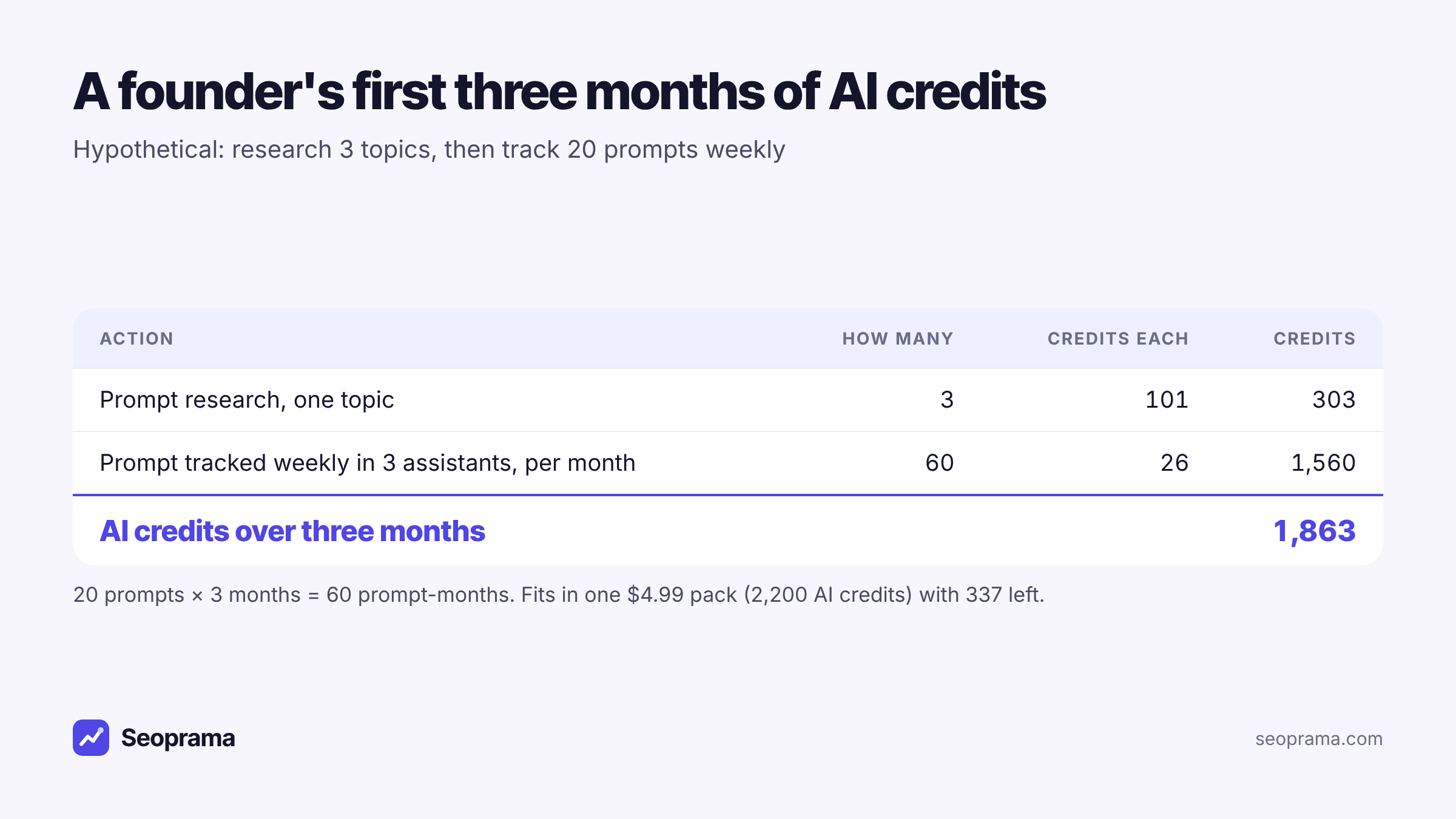
Over three months that’s 1,863 AI credits. One $4.99 pack holds 2,200. So a founder’s whole first quarter of AI search work fits in the smallest pack.
A consultant onboarding five clients. Two topics per client to start is 10 lookups, 1,010 AI credits. That’s half the $4.99 pack, or most of one month of AI Plus Basic. Re-researching each quarter costs the same again.
An agency researching widely. Forty topics across a client list is 4,040 AI credits. That’s more than AI Plus Pro’s 4,000 a month on its own, so a $14.99 pack (6,700) or a mix of plan and pack makes more sense. If the agency also tracks prompts weekly for every client, the India Agency plan’s 12,000 AI credits is the one to price out.
Running your first prompt research lookup
Here’s how I’d spend the first 101 AI credits.
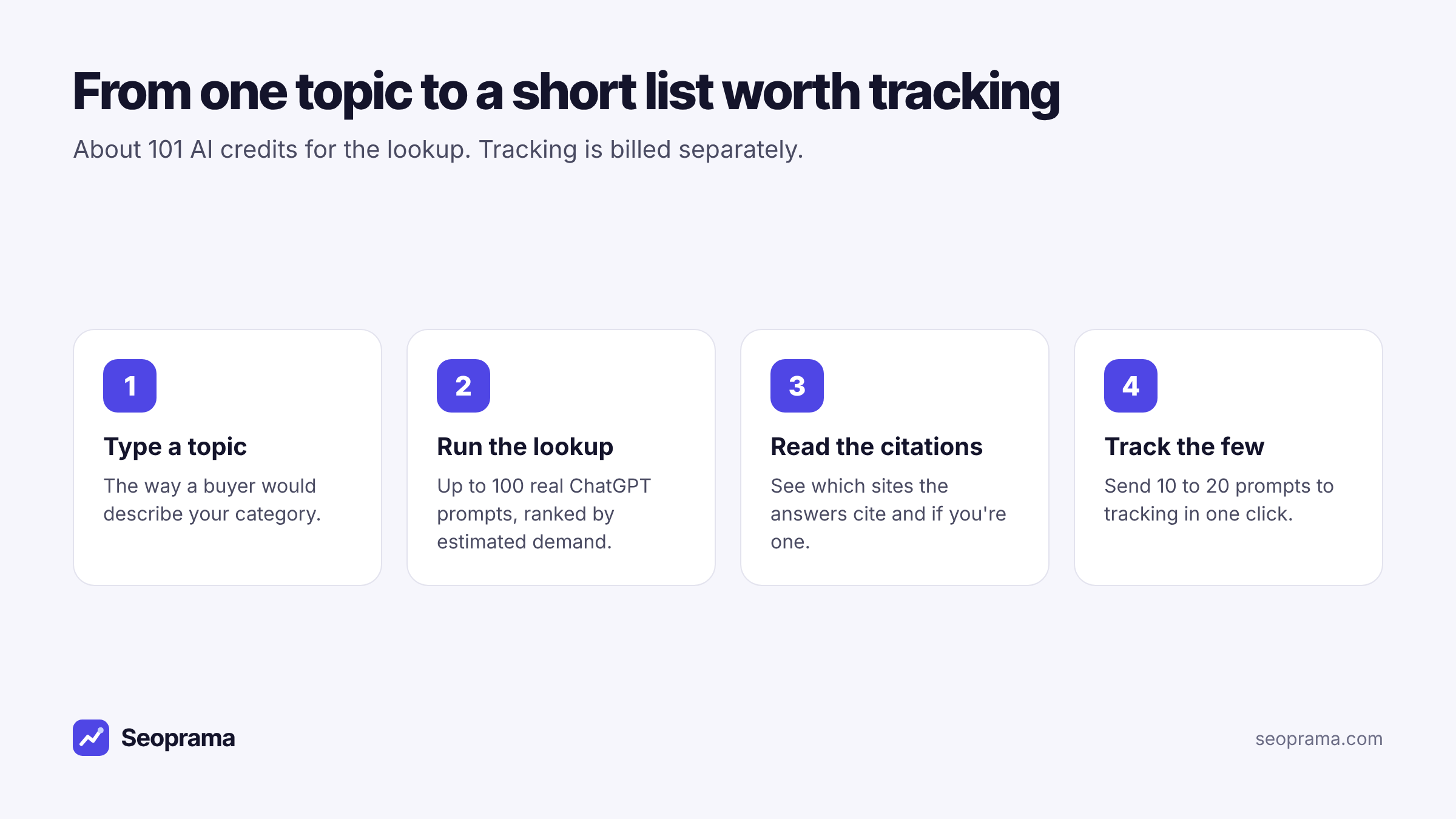
1. Type the topic the way a buyer would. “Invoicing software for freelancers” will get you better prompts than “invoicing”. Include the audience if it matters to what you sell.
2. Run the lookup. The cost shows before you confirm. You get up to 100 prompts, ordered by estimated demand.
3. Read the citations before the prompts. The most useful thing on the screen is often the list of sites the answers cite. If the same review site or forum turns up again and again, that’s a site worth getting onto, whatever you do about the prompts.
4. Pick 10 to 20 prompts and track them. Each prompt has a one-click button to send it to prompt tracking. Prompts you already track are marked, so you won’t double up.
A field note: the prompts with the most estimated demand are rarely the ones to track first. “What is invoicing software” gets asked a lot and sells nothing. Look for prompts with a constraint in them, like price, team size or a named competitor. Those are the buyers.
Getting more out of each lookup
At about 101 AI credits a go, lookups are cheap enough to run freely. But a little planning still gets you better prompts for the same spend.
Go broad first, then narrow. Start with your category (“accounting software”). Read the prompts, spot the angle that keeps coming up (“for freelancers”, “with UPI payments”), and run that as a second topic. Two lookups like this usually beat five scattered ones.
Run your competitors’ framing too. If buyers compare you with a named rival, research a topic built around that rival’s category description. You’ll see the questions where they get cited and you don’t.
Write down the cited sites. Keep a simple list of every site that turns up in the citations across your lookups. After three or four topics, the same handful of review sites, directories and forums will appear. That list is often worth more than the prompts, because it tells you where to get mentioned.
Don’t re-run too soon. Results refresh at most once a day, and AI answers don’t shift much week to week. Once a quarter per topic is plenty for most businesses, unless you launch something new.
What prompt research won’t tell you
Better to know the limits before you spend.
It covers ChatGPT only, in US English. Prompt research looks at questions asked in ChatGPT in US English. Prompt tracking covers more: ChatGPT, Gemini, Google AI Overviews, Perplexity and Claude. If your customers ask in another language, or in another country, take the prompts as a starting point and adapt them.
The demand figure is an estimate. Nobody outside the AI companies knows how often a question is really asked. The figure is useful for ranking prompts against each other, not for a forecast.
It’s a snapshot. Answers and citations change. Research tells you where things stand today. Tracking is what tells you if it moves.
There’s no sentiment score. Seoprama tells you whether you were mentioned and cited, not whether the answer was positive. Read the answers for the prompts that matter most.
If you need research across several assistants and languages every week, a bigger AI visibility suite may suit you better, and that’s a fair choice. If you need a good list of questions for one market, a lookup does the job.
What about the $2.99 trial?
The $2.99 trial (₹99 + GST in India) gives you 1,000 regular SEO credits (700 in India) to try keyword research, rank tracking, backlinks and the rest. It includes no AI credits, so you can’t run prompt research on it.
If prompt research is what you want to test, buy the smallest AI credit pack instead: $4.99, or ₹249 + GST in India. That’s about 21 lookups (12 in India), more than enough to see if the prompts are useful.
If you also want to see how you rank on Google for the same topics, the trial is a cheap way to do that next to your AI research. Most founders end up wanting both views.
About 21 keyword searches, or a few searches plus a backlink lookup and a week of rank tracking. No monthly plan, and credits never expire.
Frequently asked questions
How much does AI prompt research cost?
In Seoprama, one prompt research lookup costs about 101 AI credits and returns up to 100 ChatGPT prompts with their cited sources. That’s about 21 lookups in the $4.99 AI credit pack, or 12 in the ₹249 + GST pack in India.
Is prompt research the same as prompt tracking?
No. Research finds which questions people ask AI assistants about your topic, and you run it once per topic. Tracking checks chosen prompts on a schedule to see if you’re mentioned or cited, and it costs AI credits every month it runs.
Can I use regular credits for prompt research?
No. Prompt research uses AI credits, a separate balance used only by AI features. AI credit packs start at $4.99 (₹249 + GST in India), and the AI credits you buy never expire.
Does the $2.99 trial include prompt research?
No. The $2.99 trial (₹99 + GST in India) includes regular SEO credits only. To try prompt research, buy the smallest AI credit pack or an AI Plus plan.
Which AI assistant does Seoprama’s prompt research cover?
ChatGPT, for questions asked in US English. Prompt tracking covers more assistants: ChatGPT, Gemini, Google AI Overviews, Perplexity and Claude.
Do I need an AI Plus plan for prompt research?
No. A pack is enough for occasional research. AI Plus, from $33 a month (₹1,799 + GST in India), makes more sense if you also track prompts weekly and use the SEO tools every month.