Backlink checker price in INR: pay in rupees, per lookup
What a backlink check costs in rupees, how many lookups each pack buys, what GST adds, and how to pay by UPI instead of a dollar card.
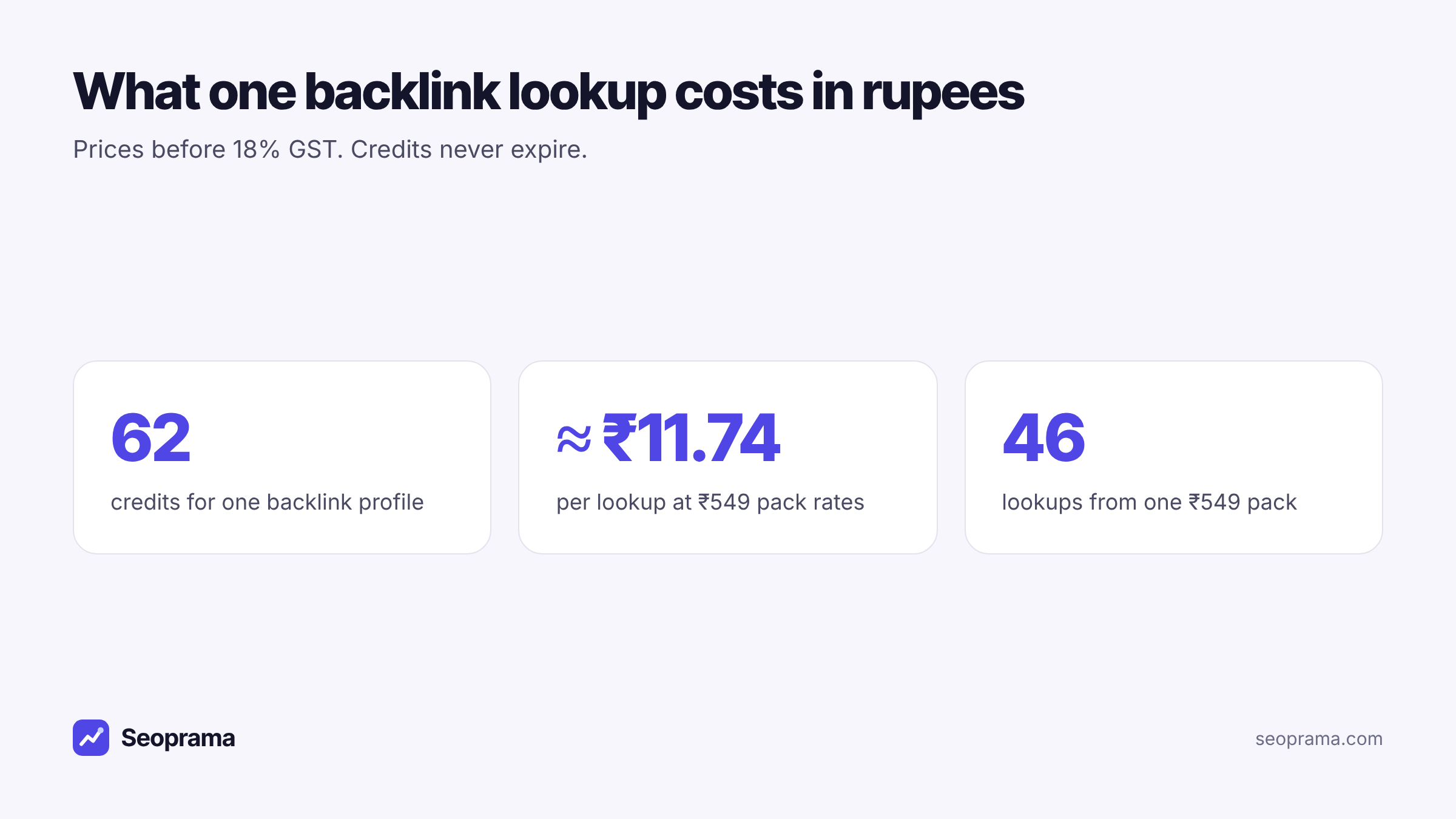
- One backlink lookup in Seoprama uses 62 credits. At ₹549 pack rates that's about ₹11.74 + GST, roughly ₹13.85 with 18% GST.
- The ₹549 + GST pack covers 46 lookups. The ₹99 + GST trial covers 11.
- You pay in rupees by UPI, card or netbanking, so your statement shows rupees, not a converted dollar charge.
- A small business checking its own links monthly and three rivals quarterly uses about 1,736 credits a year, inside one ₹549 pack.
- Credits never expire, and the same credits work on every other tool.
You want to see who links to your website, or to the competitor who keeps outranking you. Every backlink checker you find quotes a monthly plan in dollars, needs an international card, and turns into a different rupee amount every month. You just want to know what a check costs in rupees, and pay for it the way you pay for everything else.
Here’s the straight answer for Seoprama’s backlink checker: the backlink checker price in INR per lookup, per pack and per year, with GST shown separately so checkout holds no surprises.
If you’re comparing whole SEO suites in rupees, what an SEO tool costs in India covers that. This post sticks to backlink data.
What one backlink check costs in rupees
A backlink lookup in Seoprama uses 62 credits. One lookup gives you a site’s full backlink profile: links, referring domains, anchors, spam scores and the new and lost links chart.
The rupee price depends on which pack you bought. The ₹549 pack has 2,900 credits, so:
- ₹549 ÷ 2,900 × 62 = about ₹11.74 a lookup, before GST.
- With 18% GST added, that’s about ₹13.85 a lookup.
There’s no monthly fee for access. You pay for each lookup you run, and the app shows the credit cost before the lookup starts. If you check links twice this month and not at all next month, next month costs nothing.
Every rupee pack, and what a lookup costs on each
Bigger packs give you more credits per rupee. Here’s each one worked out for backlink lookups. Prices are before 18% GST, which is added at checkout.
| Pack | Credits | Backlink lookups | Per lookup, before GST | Per lookup, with GST | You pay with GST |
|---|---|---|---|---|---|
| ₹99 trial | 700 | 11 | about ₹8.77 | about ₹10.35 | ₹116.82 |
| ₹549 | 2,900 | 46 | about ₹11.74 | about ₹13.85 | ₹647.82 |
| ₹999 | 5,300 | 85 | about ₹11.69 | about ₹13.79 | ₹1,178.82 |
| ₹2,499 | 13,500 | 217 | about ₹11.48 | about ₹13.54 | ₹2,948.82 |
| ₹4,999 | 28,500 | 459 | about ₹10.88 | about ₹12.83 | ₹5,898.82 |
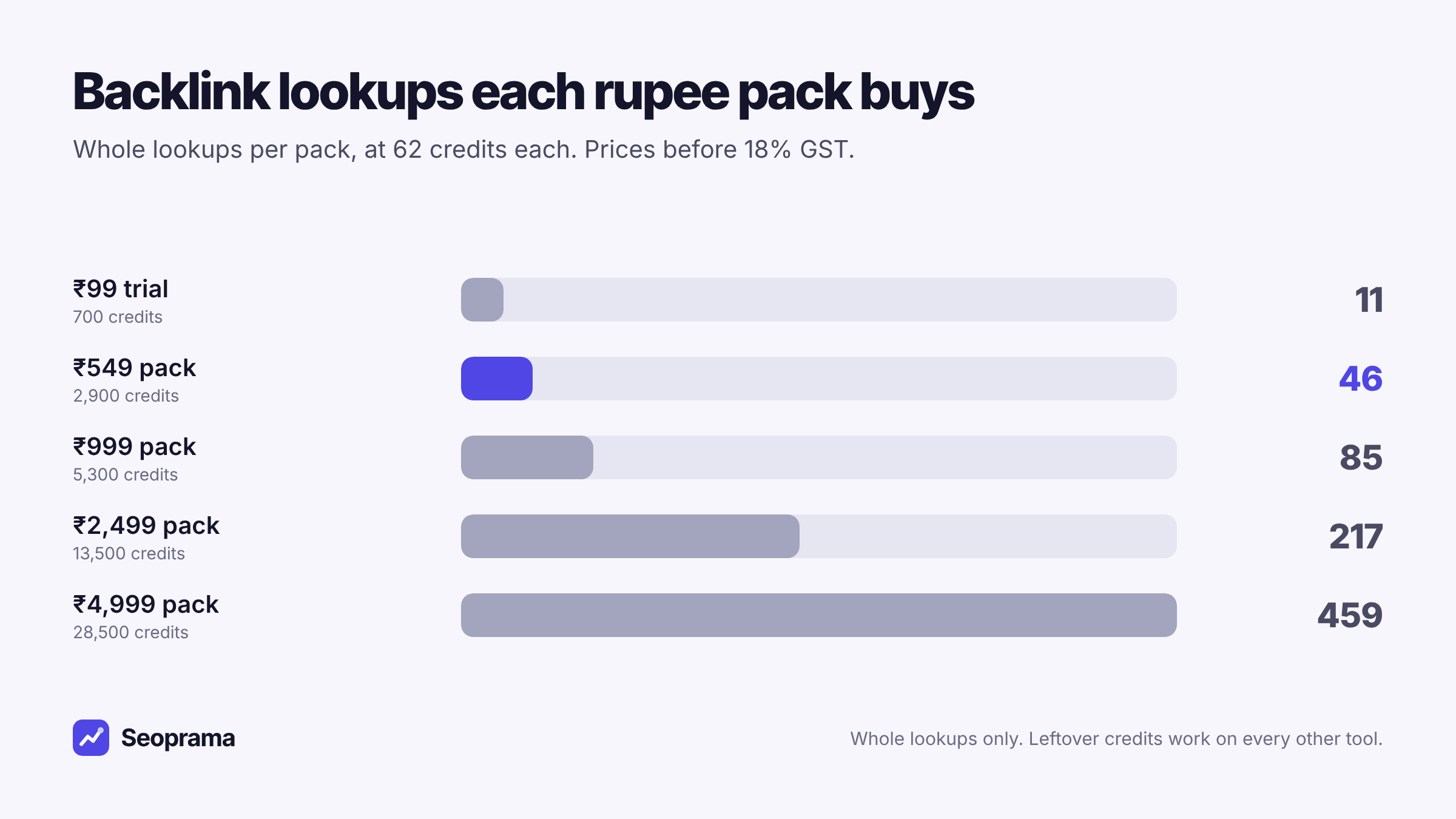
Look at the per-lookup column and you’ll see the price barely moves. From the ₹549 pack to the ₹4,999 pack, a lookup gets cheaper by under a rupee. So there’s no point buying a big pack to save money. Buy the one that covers the next few months of checks.
The lookup counts are whole lookups. The odd credits left over aren’t wasted, since they work on keyword searches, rank tracking or a site audit.
Buy credits once and spend them only when you run something. Bigger packs give more credits per dollar.
What the ₹99 trial gets you
The trial is ₹99 + GST (₹116.82 all in) for 700 credits. Spent only on backlinks, that’s 11 lookups. It’s once per account, and you can pay by UPI or card.
Most people won’t spend it all on links, and you shouldn’t either. Say you run a CA firm in Ahmedabad and want to know why two other firms show up above you. A sensible use of the trial:
- Your own site. One lookup, 62 credits.
- Your three closest rivals. Three lookups, 186 credits. Now you can see who links to them and not to you.
- A few keyword searches with what’s left. The remaining 452 credits cover 9 keyword searches at 46 credits each, enough to check what people in your city search for “GST registration” or “ITR filing”.
That’s a real look at your link gap and your keywords for under ₹117. If the data’s useful, buy a pack. If not, you’ve spent less than a lunch.
Why paying in rupees matters
Most big SEO tools bill in US dollars. That means an international card, a rupee amount that moves with the exchange rate, and, with many Indian banks, a foreign-currency markup on top. The exact fee depends on your bank and card, so check your own card’s terms. But it’s rarely zero.
Seoprama bills Indian accounts in rupees. You can pay by UPI, debit or credit card, or netbanking, and your bank statement shows a rupee amount, never a converted dollar charge. If you don’t have a card that works abroad, that alone settles it.
GST. Indian prices are shown before 18% GST, which is added at checkout. The pricing pages also let you enter your GSTIN to claim it back. If your business is GST-registered, ask your CA how they want the invoices handled.
How it compares with a dollar plan. To be fair to the big suites first: Ahrefs is known for one of the largest link indexes around, and its plans include rank tracking, site audits and keyword research too. If you use all of that every week, a plan can make sense.
But according to the plan comparison on seoprama.com, Ahrefs Lite costs $129 a month, about ₹12,384, and includes 30 backlink profiles. Thirty lookups in Seoprama is 1,860 credits, about ₹352 + GST at ₹549 pack rates, and it fits in a single ₹549 pack. That isn’t a like-for-like comparison, because of everything else Lite includes. It does show how much of a dollar plan you’d be paying for and not using if links are the main thing you check.
What you see in each lookup
The price only makes sense next to what comes back. Each lookup in the Seoprama backlink checker shows:
- A summary of backlinks, referring domains, referring pages, rank and spam score.
- New and lost links charted over time, so you can see whether the profile is growing or leaking.
- Every link, with source, target, anchor, link flags, domain strength, spam score and the date it was first seen. Each domain also shows its Ahrefs DR from Ahrefs’ free public lookup, as a familiar yardstick.
- Referring domains, each with its own link count, rank and spam score.
- Top linked pages, including broken pages that still have links pointing at them.
- Filter and export, so the list goes into a sheet for outreach.
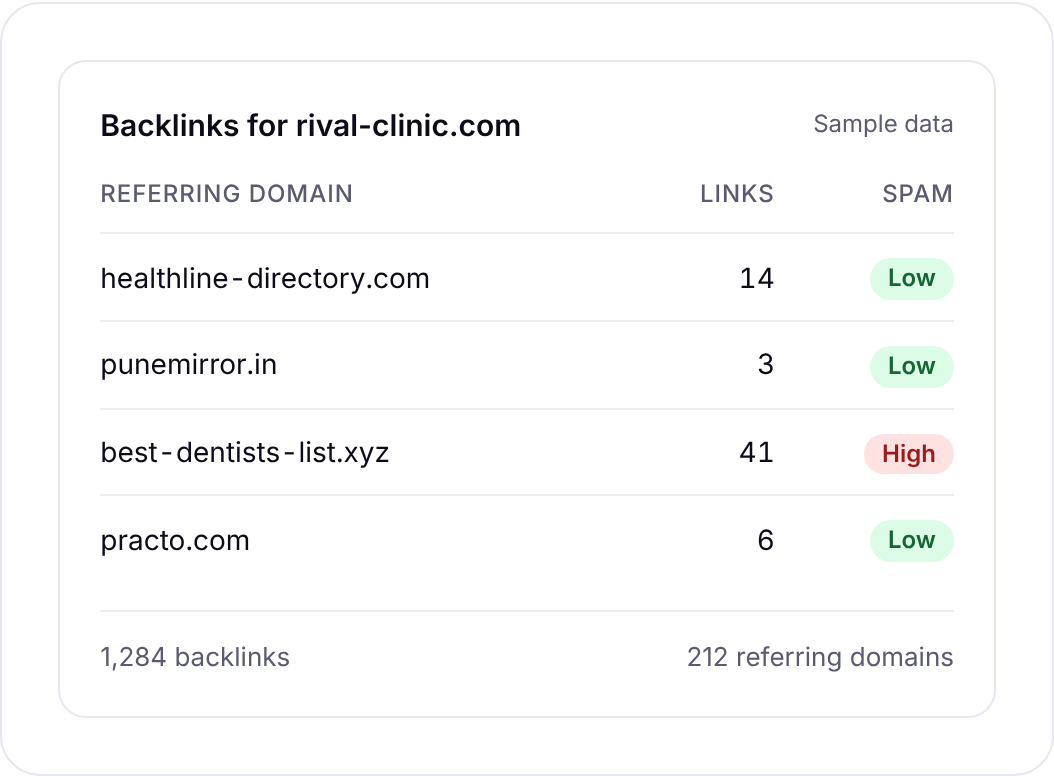
The data comes from DataForSEO’s backlink index. It’s smaller than Ahrefs’ own index, and it’s worth knowing that before you buy. For checking your own site, a handful of rivals and the links an agency says it built, it’s plenty.
For a full walkthrough of reading a lookup, from referring domains to anchors and spam scores, see a backlink checker without a subscription. The rest of this post stays on the rupee side.
Spam scores, referring domains and broken pages with links, for about 62 credits a lookup.
A year of backlink checks for a small Indian business
Most small businesses don’t check links every day. They check their own site now and then, look at rivals when rankings slip, and check once or twice when they’ve paid someone for links.
Say you run a skincare brand in Bengaluru. You check your own site once a month, three competitors once a quarter, and four other sites over the year (an agency’s sample work, a partner’s blog, a site offering you a paid post).
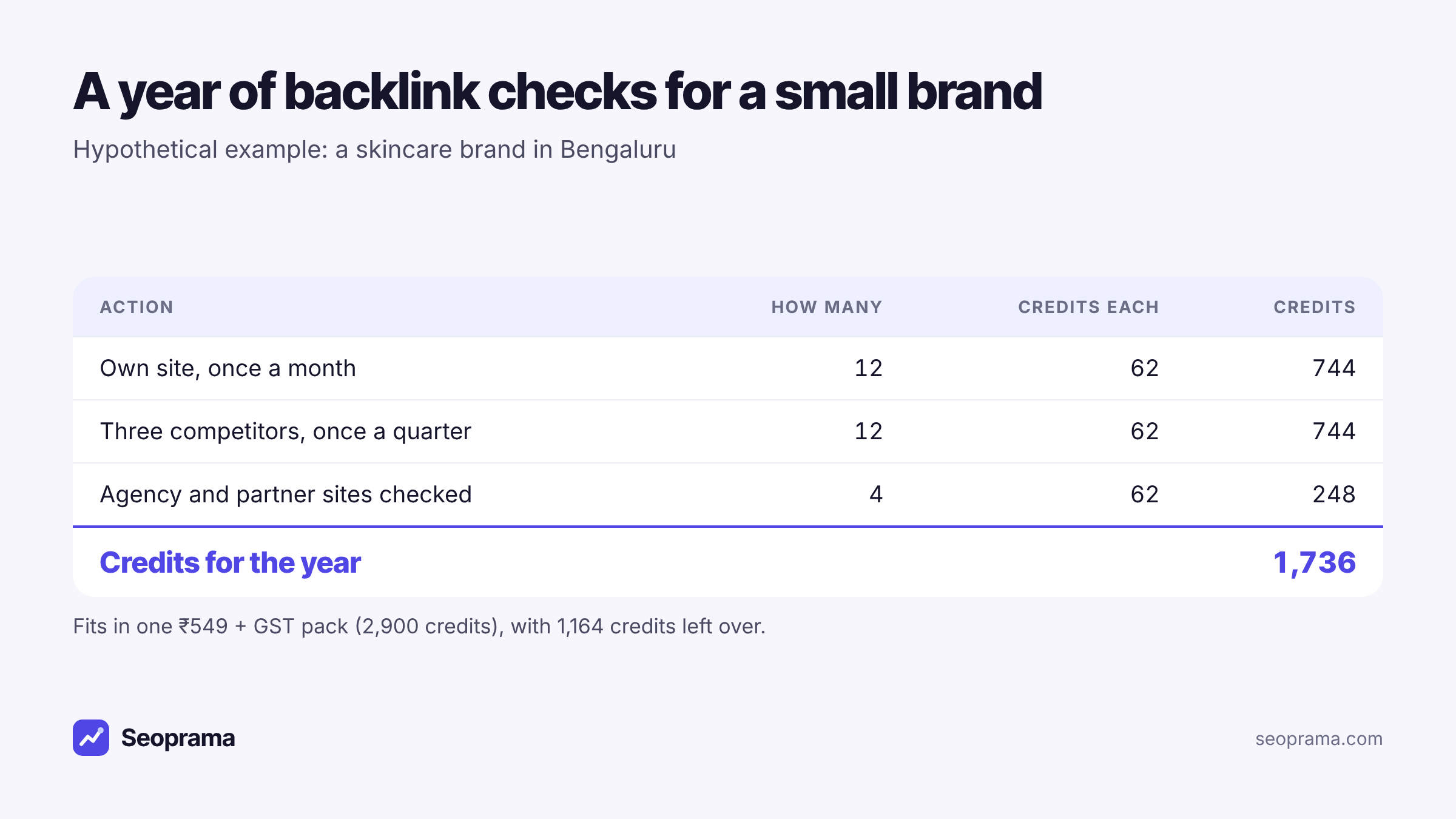
That’s 28 lookups and 1,736 credits. One ₹549 pack has 2,900, so a year of backlink checks costs ₹549 + GST (₹647.82), with 1,164 credits left for keyword research or rank tracking. Worked out at pack rates, the lookups themselves come to about ₹329 + GST.
Your numbers will differ. Count the lookups you’d really run, multiply by 62, and pick the smallest pack that covers it.
Checking the links an SEO agency says it built
This is the most useful thing a small business can do with a ₹12 lookup, and the one people skip.
Link-building packages are easy to buy in India, often priced per link or as “100 backlinks a month”. Some are good. Plenty are directory submissions, comment links and profile pages that do little or nothing. A lookup tells you which you’re getting.
Here’s how I’d check:
- Ask for the list. Any agency building links should send the URLs. If they won’t, that’s your answer.
- Run a lookup on your site at the end of the month. Look at the new links chart and the referring domains list. Do the domains on their list show up? Bear in mind a brand new link can take a while to appear, because every backlink index finds links by crawling the web.
- Sort by spam score. A batch of new links that are all high spam score is a warning sign, not a result.
- Check the link flags and anchors. Lots of links with the same exact money keyword as the anchor is a pattern you don’t want on your site.
Ten minutes and one lookup can save you months of paying for links that don’t help.
Indian link sources a lookup helps you find
Run a lookup on a competitor and you’ll usually see a mix of link types. In India, a few keep coming up for local and small businesses:
- Business directories and marketplaces such as Justdial, IndiaMART or Sulekha, depending on your trade. Directory links are often flagged nofollow and pass little ranking value, but the listings can still bring customers.
- Local news sites and city blogs that covered a launch, an event or a community activity.
- Industry associations and chambers of commerce that list their members.
- College, alumni and event pages, if you sponsor, speak or recruit.
- Supplier and partner pages that list where to buy or who they work with.
If a rival has links from three local associations and you have none, that’s a cheap gap to close. And if you want to see that gap across several rivals at once, the competitor analysis tool puts you and up to 5 competitors side by side and lists the sites that link to them but not you.
When you fix your own broken pages that still have links, check the redirect with the redirect checker before you move on. It’s 2 credits a URL and confirms the redirect is permanent.
Making each lookup count
At about ₹12 a lookup, nobody needs to ration checks. But a few habits stop you paying twice for the same data.
Export as soon as a lookup finishes. Push the links into a sheet and keep it. Next month, you compare against that file instead of re-running last month’s lookup to remember what was there.
Check rivals quarterly, yourself monthly. Your own profile is the one you act on, so check it more often. Competitors’ links change slowly, and a quarterly look is usually enough to spot new sources.
Pick rivals from the search results. Search your two or three most valuable keywords and note who ranks. Those are the sites worth a lookup, not the business you’ve always assumed is your rival.
Read the new and lost chart before anything else. If nothing moved since your last check, you can skim the rest in two minutes. If there’s a sharp drop, that’s where to spend your time.
Look at the cost line before you run. The app shows the credits before a lookup starts, so you always know what you’re about to spend.
Should you buy a pack or a monthly plan?
For backlinks alone, a pack is simpler. Pay once and use the credits whenever.
Monthly plans in India suit people who run several tools every month and want a fixed bill. They renew by UPI AutoPay or card, you can cancel any month, and prices are + GST:
| Plan | Credits a month | Backlink lookups if used only for this | Team members |
|---|---|---|---|
| Basic, ₹1,499 | 7,500 | 120 | 2 |
| Pro, ₹2,999 | 15,500 | 250 | 3 |
| Agency, ₹9,999 | 55,000 | 887 | 10 |
Per lookup, a plan isn’t cheaper. Basic works out at about ₹12.39 a lookup before GST, against about ₹11.74 on the ₹549 pack. What a plan buys you is a monthly top-up and room for your team.
My honest advice for a small business: start with the trial, then a ₹549 pack. If you’re buying a pack every month and also running rank tracking and audits, look at a plan then.
Here’s a two-minute tour of the workspace, including the credit cost that shows before every lookup.
If you want to see your own link profile today, the ₹99 + GST trial covers your site and three rivals with credits to spare. Pay by UPI, run the lookups, and you’ll know in ten minutes whether the backlink data is worth a pack.
About 21 keyword searches, or a few searches plus a backlink lookup and a week of rank tracking. No monthly plan, and credits never expire.
Frequently asked questions
How much does a backlink checker cost in India?
In Seoprama, one backlink lookup uses 62 credits, about ₹11.74 + GST at ₹549 pack rates. Packs start at ₹549 + GST for 2,900 credits, which covers 46 lookups, and there’s no monthly fee unless you choose a plan.
Can I pay for a backlink checker with UPI?
Yes. The trial and packs can be paid by UPI, debit or credit card, or netbanking, in rupees. Monthly plans renew by UPI AutoPay or card and can be cancelled any month.
Is GST added to the price?
Yes. Indian prices are shown before 18% GST, which is added at checkout. The ₹549 pack comes to ₹647.82 with GST and the ₹99 trial to ₹116.82.
How many backlink checks do I get for ₹99?
The ₹99 + GST trial gives you 700 credits, which is 11 backlink lookups if you spend it only on links. It’s once per account, and the credits also work on keyword research, rank tracking and the other tools.
Do unused credits expire?
No. Credits you buy never expire, so a pack bought for one round of competitor checks keeps working for the next one months later.
Is the backlink data as big as Ahrefs’?
No, and it’s fair to say so. Ahrefs is known for one of the largest link indexes. Seoprama’s data comes from DataForSEO and suits checking your own site, a few rivals and an agency’s work, at a per-lookup price in rupees.